
See the full water picture
Bring together water use, tanker supply, treatment, and reuse data so communities can spot avoidable losses.
We are building practical ways for communities to save water, reuse it well, and understand where every litre goes.
Get free STP guidanceWe envision communities that know their water, protect it, and use it again wherever it is safe and practical.
To develop and share engineering and technology solutions that help Bengaluru communities reduce freshwater demand and make water reuse dependable.
We will start with apartment water systems, learn from real operations, and measure outcomes before scaling an idea.
Bring together water use, tanker supply, treatment, and reuse data so communities can spot avoidable losses.
Study the day to day performance of apartment sewage treatment plants and turn operating lessons into practical tools.
Document methods and measured results so other communities can adapt solutions to their own systems.
ZioFlush is our proposed residential water-saving initiative. For a three-person home, a 40% reduction from a 6 L baseline would save around 10.5 kL a year, assuming four flushes per person at home daily. These are design targets to be tested, not proven savings.
For homes and apartment communities. Target price: around ₹3,000 per unit, subject to prototype performance and production costing.
Record baseline water use and repeat flushes.
Test water delivery, reliability and cost on common fixtures.
Trial in homes, then publish measured outcomes.
The city’s solid-waste department lists 29 lakh households. If each has three residents, four home flushes per person daily, and a compatible toilet that achieves the 40% target, the potential saving is 83.5 million litres per day.
29 lakh × 3 people × 4 flushes/day × 2.4 L saved × 365 days
This is a potential-impact calculation, not a forecast or measured result. The 29 lakh household figure does not establish toilet compatibility, actual flush volume or adoption. We will verify water use, clearing, bowl cleaning, trap-seal refill and repeat flushes in pilots before making a savings claim. At an illustrative ₹150/kL marginal water cost, a three-person home meeting the target would save about ₹1,577 yearly; simple payback on ₹3,000 would be about 1.9 years, excluding installation, power and maintenance.
When water use is invisible, waste can go unnoticed. Individual meters help households understand their consumption and help apartment communities make decisions using readings rather than estimates.
Installing a meter does not automatically reduce consumption. Savings come from reviewing readings, investigating unusual use, fixing leaks and changing everyday habits. The results must be measured; a fixed percentage saving is never guaranteed.
See how many litres your home uses over time. Compare your own usage before and after a change, while accounting for occupancy and days away.
Unexpected or continuous flow can prompt a plumbing check. Regular readings help reveal patterns; automatic alerts require a meter and monitoring system that supports them.
Verified readings can support a usage-based share of water costs if the community adopts it. Common-area use, fixed costs, vacant flats and faulty readings still need a clear, agreed policy.
Measure the effect of leak repairs and water-saving fixtures. Combine flat readings with a building water balance to investigate shared-system losses and plan supply needs.
A limited trial in willing homes, where the plumbing allows it, can help residents evaluate the idea before deciding on a wider installation.
Measure a defined period and record occupancy, supply conditions and known leaks.
Confirm meter sizing, installation, accuracy and household access to readings.
Investigate unusual flow, repair leaks and test practical conservation habits.
Compare equivalent periods and report litres saved, actual costs and limitations.
Reliable supply and careful use serve different needs. Metering helps us understand demand regardless of the source. Supply improvements, safe STP reuse and conservation can be planned together.
Valves isolate a flat for maintenance or shutoff. Meters measure the volume flowing to it. If pipes need replacement, compare the essential repair cost separately from the additional cost of metering.
It may help reduce avoidable demand, but tanker savings depend on actual supply shortages and water saved. Assess installation, plumbing, subscriptions, maintenance and replacement costs against verified savings. Electricity and repair costs do not necessarily fall in proportion to litres saved.
Share the full scope and cost, meter maintenance responsibilities, reading access and privacy, billing rules, and a process for disputed or faulty readings. Record the community decision through the process required by the association’s governing documents; attendance at a discussion should not be treated as an affirmative vote.
Further reading: EPA WaterSense guidance on leak detection and flow monitoring. This explains how monitoring can identify unusual water use; it does not establish savings for a particular apartment.
“In 2024, our apartment faced a failing sewage treatment plant. We documented the faults, organised a renovation, and began rebuilding the discipline needed to operate it every day.”
— Pramod Kalyani, cofounder
Read the 2024 renovation storyZIO-FOUNDATION is being shaped by Pramod Kalyani, Balasubrahmanya, and Priya. At Purple Garden Apartment, Pramod also encouraged residents to consider individual water metering and prepared a proposal to make each home's use visible. These community experiences inform our approach to measurable water savings.
Our proposed founding structure brings together product development, community programmes, and stewardship. Priya Kalyani is proposed as Chairperson; Pramod Kalyani would lead R&D and product development, and Balasubrahmanya Belur Srinivas would lead programmes and community work.
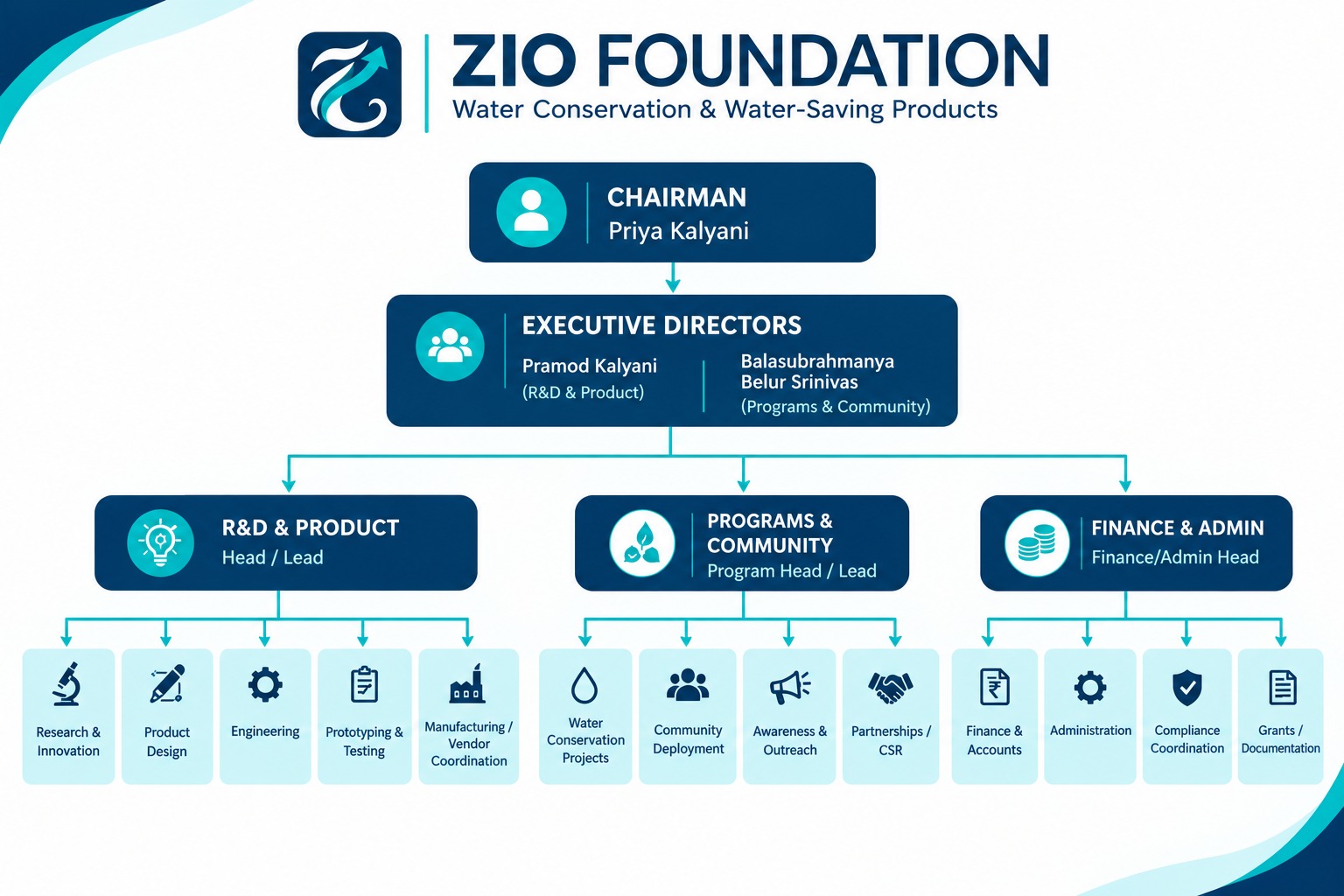
Roles and titles shown here are proposed and will be updated after the organisation is formally established.
Understand the water challenge with residents and operators.
Establish a baseline before claiming an improvement.
Test an affordable, maintainable intervention.
Publish the learning and improve the next version.
If your apartment's sewage treatment plant is underperforming, difficult to maintain, or due for renovation, we can help you understand the problem and decide what to examine next.
Request a free online consultationAn initial discussion to understand your STP, the symptoms, and sensible next steps.
When available, share the STP capacity, a brief description of the issue, recent water quality test reports, and photos of the plant. We will review the information remotely and identify questions to take to your operator or service provider.
Site inspection, testing, detailed engineering, and renovation execution would need separate assessment.
Our work begins with practical questions raised in apartment communities.
Pramod Kalyani encouraged residents to explore apartment-level water metering and prepared a proposal covering the building's shared plumbing, meter and piping options, usage visibility, leak alerts, and fair pay-per-use billing.
The proposal set a 30% water-saving aspiration. This is a planning target, not a measured outcome; installation, savings, and payback have not been verified here. Explore the benefits and questions around water metering.
From the July diagnosis through the August repair programme and September operating logs, our first case study shows how a community brought its water system back into focus.